


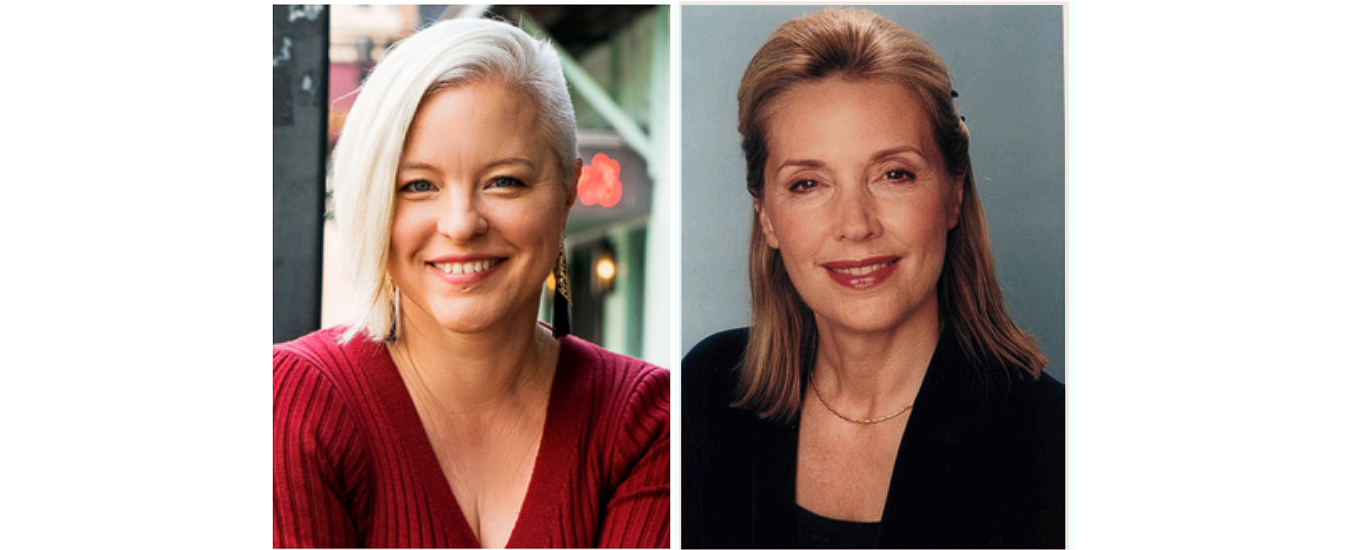
Laura Jurgens and Aline LaPierre
Laura Jurgens: Aline, you're one of the most brilliant minds in the world when it comes to understanding how our bodies hold our stories and relational traumas, and how attuned, consensual touch can be critical to healing.
And I am thrilled to be chatting with you because I love talking with you.
Aline LaPierre: Thank you, Laura. You're so generous.
Laura: We're co-creating a new course for couples, and I know, from my work with couples, that when most people hear the phrase therapeutic touch, it can be a little confusing. They either think about massage, or, here in the US, we often have a blank in our minds about what else it might involve, or we become a little nervous about boundaries.
Aline: Touch is our first language. Before we open our eyes or can speak, when we are babies, we are held and touched. Our baby bodies are cared for through touch.
How we are touched at the beginning of life starts to inform us about what the world is like. How our caregivers imprint our original blueprint through how they touch us starts really early. Truly, it begins in the womb, but for the sake of this conversation, we'll start at birth.
The way we're touched after we're born tells us whether this is a loving world, a harsh world, or a scary world. Is this world going to welcome me? Am I wanted? The basic pieces of our identity begin to form from the way our caregivers touch us at the beginning of our lives.
Laura: It's so true that touch is our first language. I am someone who spent a lot of time and many years getting back into my body, and more years helping other people get back into theirs. So this really resonates.
What do you think the practical implications of this are for couples? Why do you think couples should care about touch?
Aline: Those early imprints around touch are established before we mature and develop a desire for intimacy and sexuality. If our body has learned that touch is going to be harsh or misattuned, it later creates problems with how we receive our partner's touch. Most of us are never taught how to touch in a sensitive and attuned way.
Laura: If we didn't receive attuned touch, we might not have been able to intuit it either.
"Do you like how your partner touched you?"
Aline: When couples come to me for therapy, one of the first questions I ask them is, "Do you like how your partner touches you?" There is often an embarrassed look, as if they were thinking: "How can I possibly say this in front of my partner?" Usually, the issue revolves around misattunements. It doesn't feel like their partner is present, or there's too much pressure or not enough. Somehow, the touch falls short.
Laura: I see a lot of that. Or there is something about the repetitive touch they are receiving. I see many couples where the energy behind the touch or the groundedness might be missing, but people often lack the words to describe it.
Aline: Right – we live in a world that doesn't have explicit verbal language around touch. Very often, when someone asks, "Would you touch me in a particular way that feels good to me?" the other person receives it as a criticism. Often, we think that we need to tolerate whatever touch we're offered. Most people believe it is not okay to give feedback or to work on getting it right together.
Laura: Could you share a bit more about the origins of NATouch and how people who aren't therapists or bodyworkers can get an understanding of what it is and where it came from?
How NeuroAffective Touch Began
Aline: I can start by discussing its origins. The modalities we develop always stem from our own personal experiences, and I have always been interested in psychology. I started as a painter. At one point, I realized that the gestures I made with my paintbrush, as they appeared on the canvas, were emanating from the energy patterns within my own body.
I thought to myself, "If I'm going to put my work out there, I don't really want to put out my own unconscious limitations." I began receiving bodywork and exploring various methods to release these restrictions.
At the same time, I was also studying psychology because I wanted to gain a deeper understanding of the human psyche. Where do images come from? What are they expressing?
I realized that in the world of therapy, body and mind are two separate worlds that do not come together. When I was painting, they were together. In the world of healing, psychotherapists do not tread on the territory of the bodyworker, and bodyworkers do not dare go into psychotherapy. These were, and still are, tightly held ethical taboos.
The belief is that these two worlds should never overlap, let alone come together. Here I was, studying psychology and learning bodywork, because I thought this would help me become a better artist. I went to my therapist, and then on to get bodywork from someone else.
So I started exploring how to bring them together. At that time — which was many years ago — the field of somatic psychotherapy was just beginning. Others were also seeing the same thing I was, and asking the same question: Why do we have this split between healing the body and healing the mind? It has to come together! I found a community of people exploring the same intersection.
Laura: As a graduate of your training, I can see that NeuroAffective Touch is an evolution of all that. It's a true body of work that has landed to make that bridge, that connection between body and mind healing, a reality for many practitioners.
Aline: Yes. I will add that one of the things that happened in the early somatic world — a reaction to talk therapy being so mind-oriented — was the notion of getting the mind out of the way, because it was the body that was important. So the somatic world perpetuated a split of its own. For many years, somatic therapy was about working with the body and trying to get the mind out of the way. But that doesn't work either.
Through neuroscience, we understand that most bodily signals are transmitted to the brain for processing and facilitate the body's behaviors. There is no split. In NeuroAffective Touch, I began what I call Body-Mind Dialogues.
What is the body's story? What is the mind's story? They are often quite different stories. How do they come together? I started thinking of body and mind as a couple; are they in a good or a bad marriage? Because divorce is not an option!
Laura: Exactly! So many of us try, but it doesn't mean that it's actually working. It never does. I walked around for many years like a disembodied head. Even when we think we are separate, we are never truly so; even if we're trying not to listen to our body, we are still influenced by it, and it continues to carry a lot of things for us.
For me, NeuroAffective Touch is a beautifully gentle yet incredibly powerful way of integrating our stories, touching things we can't always feel, or can't even remember. Sometimes the body holds those stories for the mind, and through touch, we can release and bring them forward, allowing us to work with them.
NeuroAffective Touch and Intimate Connection
Laura: What do you think about the applications of NATouch for relationships, intimate partnerships — particularly couples — and families? I found this to be a crucial missing piece in helping people recognize the subtle ways we have accumulated habits of distancing from ourselves and from each other, whether through major attachment traumas, relational traumas, or even cultural disconnections that disconnect us from both ourselves and others.
Why do you think NeuroAffective Touch is so effective with that type of healing?
Aline: You're circling the topic of attachment. Our bodies are wired for connection! Our hearts yearn to love and be loved. However, in many families, various forms of emotional and relational traumas are present.
This is not to blame anyone, but these emotional and relational traumas cause disconnection. Every time there's a disconnect in a relationship, it causes a little jolt or a shock to the heart. We feel it in our chest, but often, we can't show what we feel. So we brace around our jaws, neck, and thoracic inlet to hold in or hide those shocks to the heart. Pretty soon, we become encased in this bracing so that it's hard to feel our own hearts. And when we come into relationship, our body carries the trauma of disconnection and broken relationships.
With NATouch, the touch is an attunement to emotional connection. It's not massage or deep tissue work, though these are fine options in other contexts. When we invite our nervous and emotional systems work together, we encourage a neuro-affective communication that touches those places that carry the story of misattuned, broken, abused, and neglected relationships.
Laura: Absolutely. Something I often observe in my practice, as well as in my own relationships and within myself, is the presence of these seemingly invisible patterns. Because we've carried them for so long, we might not notice the tension or the bracing, but there are these invisible barriers we carry forward that live in our nervous systems. It often begins in childhood, although it can also occur later in life, often due to misattunements or relational traumas.
Whether we're in a great relationship or we're struggling with connection, we can still feel blocked in some ways, and we might not understand that a lot of it is related to those little accumulated wounds that have caused some of that bracing. This can be true even if you think you don't have attachment issues, or you may be someone who knows that you're dealing with attachment issues, or there may be other disconnections that are happening to you, like sexual disconnections or communication breakdowns.
So I invite everyone to be curious about whether there might be some ties to the past that you may be carrying forward in some braced way.
Aline: The mind may not remember or know, but the body remembers. We can begin a dialogue where the mind is interested and wants to know: What is that bracing pattern? Why do I feel intimidated by intimacy, for example?
Then we invite the body to tell its story. The body remembers those events that shut us down. So it's a matter of giving the body center stage, and asking the mind: "Would you step back for a moment to be a witness and become curious? The body has something really interesting to tell us about what happened to you that you, mind, may not remember. But the body remembers."
Laura: Absolutely. Sometimes the mind doesn't remember at all, or it has minimized the event, saying, "Oh, it can't be that big of a deal," or "I shouldn't worry about it," or "it was a long time ago." However, it may still be affecting us today.
Aline: Yes! People say, "Oh, that was the past, and I've moved on." The mind may well have moved on, but the body doesn't move on until we hear its story. That is true even in our friendships: Sometimes we hold things back, and it affects our capacity to trust the other person or to be open. This is like that. The body is waiting. The body is very patient. It will wait, sometimes 30 or 40 years, until somebody says, "There may be something you haven't been able to express yet." We use touch to support the body in finally telling its story.
Laura: When you think about adult relationships, intimate relationships, and sexuality, can you give an example of something that you've seen about how childhood or historical attachment wounds might have affected somebody?
Aline: There are many examples, but I can think of two in particular. One is related to neglect. Families that don't touch neglect the child's need for attuned, safe, physical contact.
The other example is related to abuse, which is a huge problem. Sexual abuse or physical abuse are dysfunctions of touch. Touch is used to invade, abuse, or use another person against their will. Especially with children who cannot fight back, who cannot run away, who have to just bear it and hold in until it's over, a numbness happens in the body. Later, when a partner comes to touch their body, they will automatically go into protective patterns against invasion or intrusion, and not feel the loving intention of a partner.
Laura: Absolutely. What about neglect? How do you see that show up?
Aline: The sensors in our skin develop as a result of how we are touched. If we're not touched, a whole layer of sensory receptivity fails to develop. If someone touches you, you may think, "So what?" You may feel nothing because the receptors for touch didn't develop; they weren't needed. The body develops in contingency with the life we lead.
Laura: Absolutely. I've seen clients with a lot of early neglect in their lives who enjoy firmer or sharper touch than their partners know how to give or feel comfortable with. So we have to help everybody practice how they can touch in the way that works for their partner, and see that it's okay.
Aline: That is what we call attuned touch. We can ask, "What happened to my partner?" We don't have to be our partner's therapists for that.
Laura: It's absolutely better not to be our partner's therapist!
Aline: Right! We are simply asking, "What happened to you? I love you. I want to help you gain back this wonderful experience of being connected."
A tremendous gift a partner can give to their loved one is to say, "I will take the time to explore with you what your body needs to heal, what didn't happen for us to truly connect."
Laura: Absolutely.
Breaking New Ground: Introducing NeuroAffective Touch to Couples
Laura: That is the perfect segue to sharing our vision for introducing NeuroAffective Touch to couples. Would you like to share your vision for that?
Aline: Do you want to go first?
Laura: We're envisioning working with people in adult relationships who are already typically touching each other in a romantic context. Sometimes more or less, sometimes it could be better, it could be more attuned, but there's already someone there with whom you have a consensual relationship around touch. It's someone who hopefully has your best interest at heart and wants to be there with you, deepening your connection.
I am really excited about the possibility that you don't have to be a therapist or a bodyworker to help your partner. We don't actually want to be our partner's therapist or psychoanalyst. However, we can still play a pivotal role in supporting healing from past misattunements or relational wounds. And so I'm very excited about this work for that reason.
It's also a beautiful playground for how we can support each other in achieving what we want and what our bodies truly need to be the most vibrant and have the most aliveness flowing through us. And learn to use that aliveness to reinforce our connection. That's just such a beautiful thing.
Aline: I'm totally in alignment with you, Laura. And this is one of the reasons we're offering this course together; we are truly in alignment in our approach.
I will add a few things. What came to mind as you were talking is that, if we have some form of trauma around touch, and we go to a somatic therapist, we get an hour of touch. And then, we go home, and our partner lacks the knowledge and attunement we learned in our session. We get an hour a week, or if we're lucky, two hours a week, but we are still on our own.
With our partners, we're together all the time. We sleep together, our bodies are together. It's such an opportunity for deep healing, because what we do know about the body is that it learns through repetition. The more we practice, the more we do something, the more we spoon and cuddle up, the more our body learns to trust and love being in connection.
Laura: Absolutely. It's a perfect way to release more of that deep bracing, to have more flow of our life force energy, through all the positive repetition we get. I'd like to share a brief story from my practice, where we utilized a wonderful application of NeuroAffective Touch with a couple.
One of my clients had a really horrible incident happen when she was a baby, where one of her parents accidentally ran over her with a vehicle. She was severely injured. She was in a field. It was good that she was in a field because it seems like it pushed her down enough into the ground that she wasn't killed. Her parent had to drive off to get help for her, and couldn't move her because she was so injured. And so then she was left there. While she had done all kinds of psychotherapy and even Somatic Experiencing around the trauma of the injuries, having been abandoned in her moment of pain, she was holding a lot of bracing and a lot of relational touch needs around being comforted.
One of the things we did was show her partner that her body wanted to be held very tightly in a nurturing way, almost like a cradle. When I found that out, by experimenting with her in her body, I could then teach her partner how to do that.
They changed their nighttime routine so that he would actually spoon her at night in that same position. They incorporated that. They had been cuddling already, just in a different way that wasn't what her body needed for healing this particular area.
So they shifted to this particular type of cuddling and sleeping position. It was easy for them to do, but they hadn't known until they had the space to really open it up and listen to her body about what it needed. It is a really great example of what you were saying, Aline, about how much repetition is available with our partners.
Aline: It's also a really good feeling as the partner of someone who has a special need to be able to offer that. It's really heartwarming.
Laura: Absolutely. Most people don't have such a harrowing experience, but almost all of us have some way that our body has been holding on to something over our lifetime. It may not be so dramatic as that, but it could still be getting in the way of our expansion and our joy and freedom in our bodies.
Aline: When all of that is healed, then the way is open to play with each other in an expansive and free way.
There are two parts to this. There is the healing of the trauma. Then, as the trauma heals, there's what is called post-trauma growth. We still need support to continue growing in joy and in the pleasure of being free of trauma.
Sometimes I will see partners who aren't quite in the same place in their development; one partner carries a lot of trauma in need of healing, and the other doesn't. It can create real friction because the partner who needs the healing needs a specific attunement. And the other partner is just ready to go. It's essential to understand this to bring couples together in a similar mindset.
Laura: The fact that we can actually heal some of this through pleasurable touch is really exciting, and how, on the other side, we have access to more pleasure when our body is not holding all those bracing patterns. We get access to more full-body pleasure, which is pretty exciting, too!
So, should we talk a bit about this public course? Because of the vast healing potential here, Aline and I have put our heads and our hearts together and come up with a course called Thriving Together: Couples Healing Attachment Patterns Through Touch. Aline, what are you most excited about with this course?
Aline: Opening up the communication! Some of my experience working with couples is that often, one person is yearning for and hungry for attuned touch, while the other person is less interested in it. So how do we get both people equally interested in being there for each other in those ways? That can be a considerable challenge because it involves opening up what is known as implicit communication.
When we talk to each other, that's explicit communication. We're telling each other with words about our experience. But with implicit communication, the desire for connection doesn't have words; a kiss, for example, lives in the implicit sensory world. When somebody is attuned, they develop an intuition to touch in more implicit, attuned ways. And that feels wonderful.
We're not asking people to be mind readers. But there's a way in which we learn to listen to the body, and our body starts to have a conversation directly with our partner's body.
Laura: People could think about it as the way that your non-verbals are being communicated with each other, and having those be open and in alignment. I also sometimes think about it as a kind of full-body honesty. As opposed to holding something back, not saying something, and not attuning to either myself or my partner.
This is a really common place to be. If you're there, it doesn't mean there's anything wrong with you. It simply means you may not have received the right tools yet. We don't get taught these things in modern society.
Very early on in life, we're taught to sit still, be quiet, and ask if we need to use the bathroom. We are taught to pay attention to somebody else on their timetable. We often restrict some of our implicit communication. We're going to open that up and explore it in our course.
It will be a 6-week live training meeting on Sunday mornings, starting in February 2026. We'll meet at 10am Pacific time for an hour and a half to two hours. We will have a practice and a Q&A each time we meet.
We'll start by exploring attunement; then we'll focus on presence, intention, and attention around touch, offer an embodied repair process, how to break down barriers that act as roadbumps to authentic connection, and how to use the energies of healing and pleasure to awaken the capacity for more joy and aliveness, rather than just fixing problems.
We'll be sharing practical tools for couples to add to their toolbox, including creating more nervous system safety together to enable support for each other's healing, dismantling deep-bracing patterns, healing attachment wounds, and accessing deeper levels of trust and intimacy.
It's not about being therapists for each other. It's about becoming secure bases for each other's healing.
Aline: Right, because that kind of relationship is the basis for secure attachment and for trust. I trust that my partner really wants to find a way for me to feel and receive the love. It's about growing the love.
Laura: It's absolutely about growing the love! Is there anything you want to add about what you see people will learn or what they're going to walk away with?
Aline: This course isn't for repairing relationships that are in deep trouble. It's for couples who wish to grow together. Of course, all couples want to grow together. However, this is not the right fit for couples in crisis. There has to be harmony in the couple where both want to do this work.
Laura: Please note that this may not be suitable for you at this time, so I will add that it will remain available in the future. But if you are in a couple where your partnership is feeling really sticky, or if some resentments need to be worked through, and you're not communicating well or you're not really on the same page, then I would suggest reaching out to me or another person who works with couples to repair some of those things first. We want a solid foundation, even though we will build on it.
Aline: As you were just speaking, I remembered another important piece: the developmental sequence of our erotic capacity. From infancy, we learn to derive pleasure from different parts of our bodies. For newborns, it's the mouth latching onto the breast and feeling the warm milk open their belly. This prepares our capacity to enjoy kissing. Many parts of our bodies learn through successful development to take in pleasure.
That piece is often not addressed in sexological bodywork. Many sexological bodyworkers have come to me and said, "Aline, when are you going to offer the developmental pieces to growing our body's capacity for pleasure?"




Leave a Reply